North Georgia Rivers
The Complete Guide to Fly Fishing Noontootla Creek in 2026
 Daniel Bowman
Updated May 7, 2026
10 min read
Daniel Bowman
Updated May 7, 2026
10 min read

The short version
Noontootla Creek is the best small-water wild trout fishery in North Georgia — a naturally reproducing population of brown trout in cold, clear, mountain water on Forest Service land in the Cohutta Wilderness area. The marquee stretch is managed under special regulations: single-hook artificial flies only, slot-length limits, no harvest of trout. The creek runs 8–25 feet wide through hemlock and rhododendron canopy and demands true small-stream technique — short rods, short leaders, careful low-profile approach, drag-free drifts of 3–8 feet. Best months are April through early June for hatches and active surface fishing and October through November for the brown trout pre-spawn streamer bite. Bowman runs full-day Noontootla trips at $600. Plan on fewer fish than the Etowah or Toccoa, smaller average size than the Soque, and the most authentic wild trout experience available within 90 minutes of Atlanta.
What is Noontootla Creek?
Noontootla Creek is a freestone mountain stream in Fannin County, Georgia, draining a portion of the Cohutta Wilderness in the Chattahoochee-Oconee National Forest. The creek flows roughly 12 miles from its headwaters in the high country down to its confluence with the Toccoa River near Blue Ridge.
The fishable trout water sits mostly within Forest Service ownership. Public access is excellent for a wild trout fishery — multiple trailheads, dirt-road pullouts, and longer hike-in stretches that see fewer anglers per week.
The creek's character changes meaningfully from headwaters to mouth:
- Headwaters and high tributaries — small, technical, very wild water with native brook trout and small wild rainbows. Hike-in only on most stretches.
- Middle Noontootla — the special-regulations zone. Wild brown trout dominate, supplemented by wild rainbows. The water runs 12–25 feet wide through hemlock and rhododendron.
- Lower Noontootla — broader, slightly warmer, mixed wild and stocked fish, eventually transitioning to Toccoa River conditions near the confluence.
The middle section under special regulations is the marquee water — it produces the largest wild brown trout in North Georgia outside of guided private water, and it fishes more like a small Western tailwater than a typical Eastern freestone.
The special regulations zone
Georgia manages a designated stretch of Noontootla Creek under special regulations to protect the wild brown trout population. The exact boundaries and rules are posted at the Forest Service trailheads and on signage at access points. Key elements:
- Single-hook artificial flies or lures only. No bait. Treble hooks not permitted.
- No harvest of trout. Catch and release on all trout in the regulated stretch.
- Slot length limits apply on some species.
- Year-round open season in the regulated water (most Georgia trout water has seasonal closures).
Because regulations evolve, verify the current rules at the Georgia Wildlife Resources Division special regulations page before fishing on your own. The page lists every special-regulation trout stream in the state with current boundaries and rules.
The Forest Service also enforces general wilderness-area regulations on adjacent Cohutta Wilderness land. The U.S. Forest Service Chattahoochee-Oconee National Forest website lists trail closures, parking, and any seasonal restrictions.
Wild brown trout — the marquee population
Noontootla's brown trout population reproduces naturally. The creek does not get stocked in the special-regulations stretch; every brown trout in that water hatched from a redd in the creek itself or in a tributary feeder.
Population characteristics:
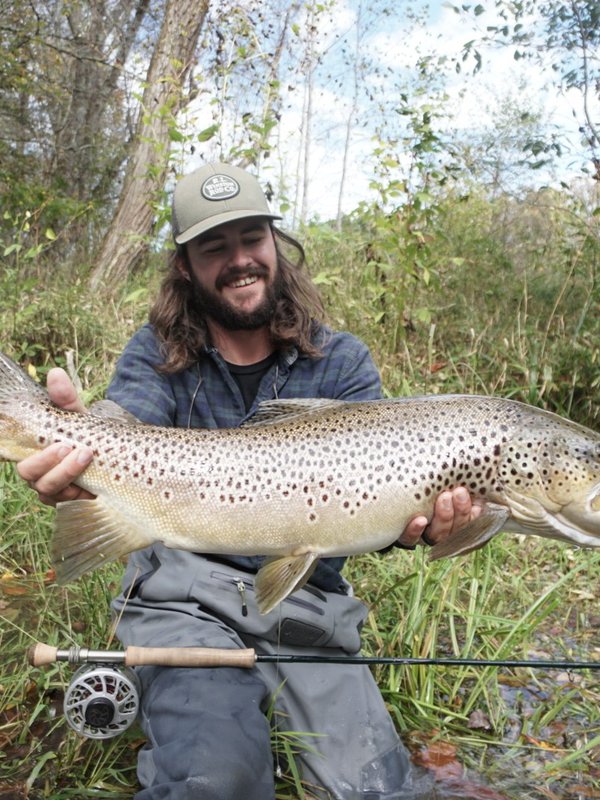
- Size distribution. Most fish run 7–13 inches. Quality wild fish run 14–18 inches. A genuine 20-inch wild brown is the trophy of the year for most anglers; a few are caught annually.
- Density. Modest. The creek holds roughly 800–1,500 catchable trout per mile in good years — meaningful, but well below stocked-stream density.
- Aggression. Wild fish that have eaten thousands of natural insects react differently from stocked trout. They are willing eaters in good conditions and almost impossible to catch on poor presentations.
- Spawning. October–November, with redds visible in shallow gravel runs. Avoid wading through obvious gravel beds during this window.
Wild rainbow trout share the creek with brown trout in the lower regulated water. Brook trout — Georgia's only native trout — populate the highest tributary headwaters above the special-regulations zone.
Hatches and seasonal patterns
Noontootla's bug life is classic Southern Appalachian freestone — diverse but rarely dense. Reading the moment matters more than over-fishing any one hatch.
February–March. Black stoneflies, midges, early Blue Wing Olives. Nymphing dominates; the rare warm afternoon brings sparse dry-fly activity.
April. The richest dry-fly month. Quill Gordons (size 12–14), Hendricksons (size 12–14), Blue Quills (size 16–18), early caddis. Browns become aggressive after the long winter.
May. Sulphurs (size 14–18), March Browns (size 12), increasing caddis variety. Late afternoons start producing reliably.
June. Light Cahills (size 14–16), Yellow Sallies (size 14), Slate Drakes (size 12–14), sporadic Green Drakes. Terrestrials become viable — beetles, ants, and inchworms after the canopy fills in.
July–August. Terrestrial season. The hemlock canopy overhead drops inchworms, beetles, and small spruce moths into the water all summer. Mid-morning and late-afternoon are the productive windows; midday on the smaller upper stretches gets too warm.
September. Cooler nights restart the fishery. Tricos in the early morning. Renewed caddis. Streamer fish start moving as pre-spawn aggression builds.
October–November. Streamer season. Wild brown trout in pre-spawn mode become aggressively territorial. Larger streamers (size 4–8) on slow, methodical strips through the deeper runs.
December–January. Midges and small mayflies. Slow nymphing on the deeper pools. Few bites but the chance at a quality fish is real.
Noontootla gear setup
Small-stream gear is mandatory. The creek does not reward 9-foot 5-weights and long leaders.
Rod. A 7-foot to 8-foot rod in 3 weight is the right Noontootla tool. Glass and slow-action graphite both work — accuracy matters more than line speed in this small water.
Line. Weight-forward floating line in matching weight, or a short-headed double-taper. Specialty small-stream lines from Scientific Anglers or RIO are worth considering for serious small-water anglers.
Leader. 7-foot tapered leader to 5X or 6X. Some anglers fish 9-foot leaders out of habit; on Noontootla, the longer leader creates wind-knot risk in the tight rhododendron tunnels and adds nothing.
Tippet. 5X for general nymphing and dry-dropper. 6X for technical dry-fly fishing on the smoother runs. 4X only for streamers in higher water.
Flies — must-haves for Noontootla:
- Parachute Adams (size 12–18)
- Elk Hair Caddis (size 14–18, tan and olive)
- Pheasant Tail nymph (size 14–18)
- Hare's Ear nymph (size 14–18)
- Foam beetle (size 14–16)
- Foam ant (size 16–18)
- Inchworm pattern (size 12–14)
- Wooly Bugger (size 8–10, black and olive)
- Sculpzilla or sculpin pattern (size 6–8) for fall streamer fishing
Wading. Studded soles or felt. Noontootla rocks are slick year-round. A wading staff is recommended for the steeper-gradient sections — the creek drops faster than the Etowah or Toccoa.
Other. Polarized sunglasses are non-negotiable on Noontootla. The creek's clarity is exceptional and reading water depth without polarization is impossible.
Approach and technique on Noontootla
Wild trout in small clear water spook at the slightest disturbance. The technique difference between a 4-fish day and a 14-fish day is mostly about approach.
1. Stay low. Crouch when approaching a pool. In the smaller upper stretches, casting from one knee is normal.
2. Fish from below. Wild trout face into the current. Approach pools from downstream and present flies upstream so the fish doesn't see you before the fly.
3. First cast counts. A wild brown trout will often eat the first decent presentation and ignore every cast after. Plan the first cast carefully — pick the line, mark the drop point, then cast.
4. Drift drag-free. Most Noontootla refusals come from micro-drag the angler doesn't notice. Mend gently, lead the fly with the rod tip, accept short drifts of 3–8 feet rather than long mended ones.
5. Read the seams. Wild trout sit on current seams — the line where fast water meets slow water. The deepest part of a run is rarely the holding lie; the seam edge is.
6. Move methodically. Three good drifts through a pool is usually the limit. Fish hard, then move. Beating a pool to death only educates the trout that live in it.
What a Bowman Noontootla day looks like
A typical Bowman Noontootla trip runs as a full day at $600. The technical demand and wading-intensive day-shape don't fit cleanly into a half-day window.
Pre-trip. Booking through the trip finder confirms date, water, and group size. Pre-trip email covers what to wear, what to bring, parking, and meeting time. Group size is typically 1–2 anglers per guide; the creek is too small for larger groups.
Morning. 8:00 AM meet at the Forest Service trailhead. Rod-up at the truck. The guide briefs the day's plan: which 1.5–2.5 miles of the creek will be fished, which pools to target, current water and weather notes. A 15–25 minute walk gets to the first fishable water.
On the water. First fish typically in the first hour. Through the morning, the guide rotates through 6–10 distinct pools and runs, coaching approach, presentation, and hookset on the way. Lunch on the bank.
Afternoon. Pace shifts toward the deeper pools and pocket water. As light changes, dry-fly opportunities open up in spring and fall, or streamer chances in cooler months. The guide reads the bug activity and switches rigs as needed.
Take-out. Walk out the same trail. Rinse and break down gear at the truck. Tip the guide (15–20% standard). Drive home.
Catch expectation: 4–10 wild brown trout on a strong day, 2–5 on a slow day. Quality over quantity. A 14-inch wild brown on the Noontootla is a meaningful trip; a 17+ inch fish is a memorable one.
Noontootla vs other North Georgia rivers
Quick orientation if you're choosing among Bowman's home waters:
Pick Noontootla when:
- You want wild trout in wild surroundings, no stocked fish
- You like technical small-stream fishing and tight casting
- You're physically able for 3–4 hours of careful wading
- You value the experience as much as the fish count
- You've already fished Toccoa or Etowah and want a step up in technical demand
Pick the Soque River when:
- You want maximum trophy density on private spring creek water
- You want bigger average fish than Noontootla offers
- You don't mind the higher rod fee for marquee trophy water
Pick the Toccoa when:
- You want a true tailwater with bigger water and bigger fish
- You want a drift boat float trip
- Your group has more than two anglers
Pick the Etowah when:
- You want a small-stream wading day with shorter Atlanta commute
- You want a mixed wild/stocked fishery rather than wild-only
- You're a first-time guided angler — Etowah's slightly easier learning curve fits
For experienced fly anglers researching North Georgia, Noontootla is often the most-rewarding day. For first-time anglers, the Etowah is usually the better starting point.
Reading Noontootla water levels
Noontootla does not have its own publicly published USGS gauge. The closest meaningful gauges are the upper Toccoa and the Cartecay, both of which respond to similar weather patterns and provide a reasonable proxy.
General level guidance:
- After 0.25 inches of rain in 24 hours: The creek bumps slightly and fishes well — stained water, active fish.
- After 0.5–1.0 inches in 24 hours: Higher and faster. Streamer fishing improves; nymphing stays productive on the bottom.
- After 1+ inches in 24 hours: Often unfishable for 24–48 hours. Wait for clarity to return.
- Drought conditions (no meaningful rain in 14+ days): Low and ultra-clear. Fishing is technical; sight-fishing becomes possible but spook risk is high.
Bowman guides watch local rainfall and Forest Service road conditions in addition to gauge proxies. If you're booking a Noontootla trip in unsettled weather, the guide will call the day before with a water-condition update.
Common Noontootla mistakes
Patterns that cost first-time Noontootla anglers fish:
1. Overcasting. The creek is too small for 40-foot casts. Many anglers cast across pools they should be picking apart in 8–15 foot drifts.
2. Wrong rod. A 9-foot 5 weight is too much rod for Noontootla. Borrow or rent a 7'6" 3 weight.
3. Wading the holding water. Walking through the slot you should be fishing kills the run for an hour or more. Walk the bank when possible; wade only when necessary.
4. Ignoring the seams. The deepest part of a pool isn't where the fish are — the seam edge is.
5. Beating a pool to death. Three good drifts, then move. Wild trout that have refused four presentations have been educated.
6. Skipping the Trout Unlimited Georgia chapter resources. Local TU chapters publish stream reports, special-regulations updates, and access notes for Noontootla and adjacent waters.
7. Not budgeting for the walk. The best Noontootla water is a 15–30 minute walk from the trailhead. Anglers who only fish the first 200 yards from parking pressure the easiest water and miss the better runs.
Frequently Asked Questions
Where is Noontootla Creek?
Noontootla Creek is in Fannin County, Georgia, in the Cohutta Wilderness portion of the Chattahoochee-Oconee National Forest. The marquee special-regulations stretch is approximately 90 minutes north of Atlanta via GA-400 and US-76. Trailhead access is via Forest Service roads off Doublehead Gap Road.
What gear do I need for Noontootla Creek?
A 7-foot to 8-foot rod in 3 weight, weight-forward floating line, 7-foot leader to 5X or 6X tippet. Studded or felt-sole wading shoes. Polarized sunglasses. Standard small-stream fly box of Parachute Adams, Elk Hair Caddis, Pheasant Tail nymphs, foam beetles, and a few streamers. For guided trips, all gear is supplied.
Are Noontootla brown trout wild or stocked?
Wild. The brown trout in the special-regulations stretch reproduce naturally; the state does not stock that water. Wild rainbow trout share the lower regulated section. Native brook trout occupy the higher tributary headwaters above the regulated zone.
What are the special regulations on Noontootla?
The marquee stretch is managed under: single-hook artificial flies or lures only, no bait, no harvest of trout, slot length limits on some species, year-round open season. Boundaries are signed at trailheads. Verify current rules at the Georgia Wildlife Resources Division special regulations page before fishing on your own.
When is the best time to fly fish Noontootla?
April through early June for the richest hatch activity and active wild trout. October and November for fall streamer fishing and brown trout pre-spawn aggression. Winter midge fishing is technical but rewarding for experienced small-stream anglers. Summer fishing is best very early or very late in the day.
Can beginners fish Noontootla?
Yes, but with a guide. The casting demand is short and accurate rather than long and powerful, so beginners can learn the mechanics on the creek. The reading-water and approach skills are harder for first-time anglers, which is exactly where a guide adds the most value. Beginners booking Noontootla should be honest about wading fitness — the day involves 3–4 hours of careful wading on slick rocks.
Do I need a Georgia license to fish Noontootla?
Yes. Anyone 16 or older needs a valid Georgia fishing license, plus a trout license for trout waters. Licenses are available online or at most outdoor retailers. For guided Bowman trips the guide will confirm license status before launch — make sure yours is current.
Ready for technical wild trout?
Book a guided Noontootla trip — wild brown trout, special-regs water, and small-stream tactics.
Noontootla Creek or Find Your Trip →