North Georgia Rivers
The Complete Guide to Fly Fishing the Etowah River in 2026
 Daniel Bowman
Updated May 7, 2026
11 min read
Daniel Bowman
Updated May 7, 2026
11 min read

The short version
The Etowah River is the most accessible small-stream trout fishery in North Georgia — about 75 minutes from Atlanta, with three distinct zones: wild rainbow and brook trout in the upper headwaters, stocked rainbow and brown trout in the middle near Dahlonega (where the Etowah vineyard private water sits), and warmwater bass in the lower river toward Cumming. The vineyard beat is Bowman's marquee Etowah water — limited pressure, bigger fish, scenic vineyard backdrop. The river fishes best with shorter rods (7'6"–8'6"), 3–4 weight lines, and shorter leaders than you'd use on the Toccoa or Soque. Peak months are April through early June for hatches and October through November for fall streamer fishing. Small-stream Etowah fishing rewards careful approach, short accurate casts, and reading pocket water — long-distance casting is rarely needed.
What is the Etowah River?
The Etowah is a 164-mile river that begins in the southern Appalachian foothills of Lumpkin County, runs southwest through Dahlonega, Dawsonville, and Cumming, and eventually joins the Oostanaula at Rome to form the Coosa River. Most of those 164 miles fish as warmwater habitat — bass, sunfish, catfish — but the upper third holds trout, and that's where guided fly fishing happens.
The trout-holding portion of the Etowah breaks into three zones:
- Upper Etowah (headwaters in Lumpkin County north of Dahlonega) — small streams, wild rainbow and brook trout, very small water that often runs 10–20 feet wide.
- Middle Etowah (Dahlonega to Dawsonville) — the heart of the trout fishery. Mix of stocked and holdover trout, multiple public access points, and the private vineyard water Bowman fishes.
- Lower Etowah (below Dawsonville to Cumming) — warmwater bass and panfish. Productive for warmwater fly anglers, but not a trout option.
The middle Etowah is where guided trout trips run. In that zone the river runs roughly 30–50 feet wide, with pocket water broken by riffles, runs, and pools. Most of it is wadeable in normal flows — chest-deep in the deepest runs but generally thigh-deep through the holding water.
The Etowah vineyard private water — Bowman's marquee beat
The single most-booked Etowah trip is on a private water lease alongside a working vineyard north of Dahlonega. Two miles of river, vineyard rows on one bank, hardwood forest on the other, and a stretch that fishes harder and produces bigger fish than any public Etowah water within an hour's drive.
What makes it fish well:
- Limited pressure. Only Bowman clients fish this beat. A typical week sees 6–15 angler-days, compared to dozens of anglers per day on public access points just a few miles downstream.
- Cold tributary inputs. Several spring-fed feeders enter the main stem inside the lease, keeping water temps 4–6°F cooler than the public Etowah in summer.
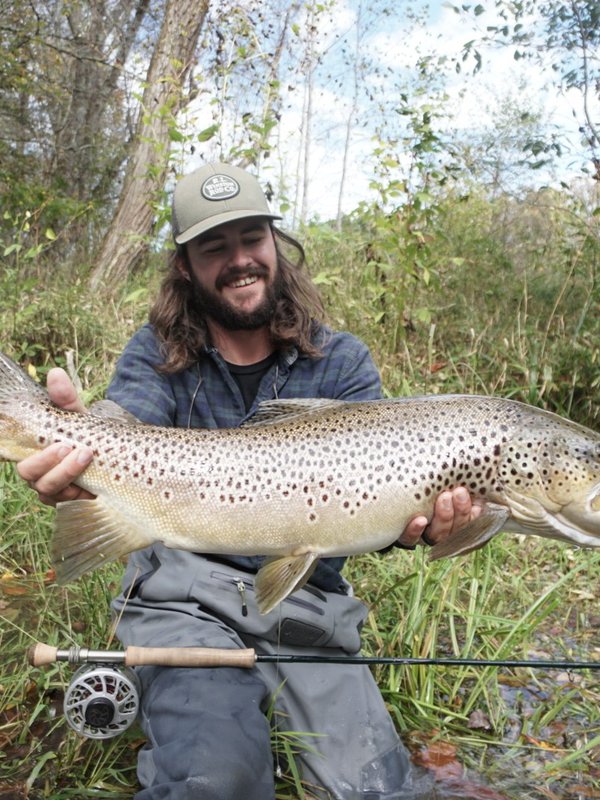
- Stocked + holdover mix. Larger trout that survive the previous season carry over and put on size. Holdovers in the 14–18-inch range are common; the occasional 20+ inch fish gets caught.
- Wild brook trout in the cooler tributary mouths and one named feeder creek inside the property.
- Multiple distinct runs. A guide can rotate clients through 8–10 named pools and runs in a half-day without backtracking.
A typical Bowman Etowah vineyard trip rotates four to six pools with the morning bite, breaks for lunch, then fishes the deeper runs and pocket water through the afternoon. Half-day trips often see 8–15 fish; full-day trips run 15–30. Quality of fish is meaningfully better than what most anglers experience on the public Etowah.
Public Etowah access points
Several public stretches of the Etowah are worth knowing about, even though Bowman trips run on private water. Public access lets you scout, return on your own, or fish second-choice days.
Edge of the World rapids (Dawson Forest Wildlife Management Area). A WMA stretch with shoals, rapids, and pocket water. Trout in the colder months; bass take over in summer. Wading is rocky and requires felt or studded soles.
Castleberry Bridge. Roadside parking, a short walk to the river, and a stretch that gets stocked. High pressure on weekends.
Auraria Road bridges. Multiple bridges along Auraria Road provide access. The water above the bridges fishes better than below.
Lower Etowah Wildlife Management Area. South of Dawsonville. Warmwater fishing rather than trout — bass on streamers and poppers.
Important regulatory context. Some Etowah stretches are stocked under Georgia's general trout regulations; a few short reaches have year-round seasonal status. Verify open seasons, length limits, and creel limits at the Georgia Wildlife Resources Division trout regulations page before fishing public water on your own. Bowman handles regulatory compliance for all guided trips.
Wild trout vs stocked trout — where the fish actually live
The Etowah is a mixed fishery. Wild and stocked fish use different water and respond to different presentations.
Stocked trout. Stocked rainbow and brown trout dominate the middle Etowah from spring through early summer. The Wildlife Resources Division stocks several access points roughly weekly during the trout season. Stocked fish hold in obvious water — runs, the heads of pools, and the deeper edges of riffles. They eat dries, nymphs, and small streamers willingly during the first 2–3 weeks after stocking, then become slightly more selective.
Holdover trout. A meaningful percentage of stocked fish hold over from one year to the next, particularly in the cooler tributary mouths and the deeper pools. Holdovers behave more like wild fish — they hold tighter to structure and respond to slightly more refined presentations.
Wild rainbow trout. Wild rainbows are present in the upper Etowah headwaters and in the cool feeder creeks throughout the trout zone. Wild rainbow on the Etowah typically run 7–11 inches; a 13-inch wild rainbow is a trophy.
Wild brook trout. The Etowah's southernmost native brook trout populations live in two named feeder creeks. Bowman's vineyard beat has access to one. Brook trout here run 5–9 inches with the occasional 11-inch fish; the size is small but the fish are dramatic.
Etowah hatches and seasonal patterns
The Etowah's bug life is varied but rarely dense. Anglers used to dense Western hatches sometimes overlook subtler Eastern hatches.
February–March: Black stoneflies and early midges. Nymph fishing on the bottom; small dries during midge emergence on warmer afternoons.
April: Quill Gordons (size 14), Hendricksons (size 12–14), Blue Quills (size 16–18), Grannom caddis (size 14–16). The richest dry-fly month of the year.
May: Sulphurs (size 14–18), March Browns (size 12), continuing caddis. Late-evening spinner falls become productive.
June: Light Cahills (size 14–16), Yellow Sallies (size 14), summer caddis. Terrestrials begin — beetles, ants, small hoppers.
July–August: Terrestrials dominate. Hoppers, beetles, ants, and inchworms outfish everything else. Early morning and late evening are the productive windows; mid-day is too warm.
September: Tricos in the early morning. Renewed caddis activity. Cooler nights start to drop water temps.
October–November: Streamer season. Brown trout get aggressive ahead of the spawn. Larger streamers (size 4–6) on slow strips through the deeper runs.
December–January: Midges, small mayflies, and slow nymph presentations. Smaller flies, slower retrieves, and a willingness to fish for fewer bites.
Etowah gear setup
The Etowah fishes differently from the Toccoa or Soque River. The river is smaller, the casts are shorter, and the wading is closer.
Rod. A 7'6" to 8'6" rod in 3 or 4 weight is the right Etowah tool. A 9-foot 5 weight will work but feels overpowered in tight sections. Glass and slow-action graphite both excel here — the river rewards delicate presentation more than line speed.
Line. Weight-forward floating line in matching weight. A double-taper line is also a solid Etowah choice for short, accurate casts.
Leader. 7.5 to 9 feet, tapered to 5X or 6X. The Etowah is small enough that long leaders aren't needed and create wind-knot risk in tight casting. Short, well-mended drifts beat long delicate ones.
Tippet. 5X for general use; 6X for technical dry-fly fishing. Heavier 4X for streamers and high water.
Flies — must-haves for the Etowah:
- Parachute Adams (size 12–18)
- Elk Hair Caddis (size 14–16, tan and olive)
- Pheasant Tail nymph (size 14–18)
- Hare's Ear nymph (size 14–18)
- Pat's Rubber Legs (size 8–12)
- Squirmy worm and egg patterns (early season, post-stocking)
- Foam beetle and ant patterns (size 14–16, summer)
- Woolly Bugger (size 8–10, black and olive)
Wading. Felt or studded soles. Etowah rocks are slick. A wading staff is sensible in higher water.
For first-timers, Bowman supplies all gear on guided trips. Bringing your own is welcome but not required.
Reading Etowah water levels
The relevant USGS gauge for the middle Etowah is station 02389150 near Canton. Real-time data is available at USGS Etowah River gauge data (station 02389150).
General level guide:
- Below 200 cfs: Low water. Wade easily, but stocking activity slows and fish get spooky.
- 200–400 cfs: Prime fishing range. Wadeable, productive, and the river fishes its full character.
- 400–700 cfs: Higher but still fishable. Streamer fishing improves. Wading becomes more careful.
- Above 700 cfs: High water. Wade fishing gets risky in many sections. Fish move to slower edges.
- Above 1,200 cfs: Blown out. Skip the trip or reschedule.
Note that the Canton gauge is downstream of the trout zone — flows in the upper Etowah where guided trips run will be lower than what the gauge reads. Use the gauge as a directional signal, not an exact measurement.
Etowah vs Toccoa vs Soque — when to pick the Etowah
Anglers researching North Georgia rivers often ask which to pick. Quick orientation:
Pick the Etowah when:
- You want a small-stream experience rather than tailwater or spring creek
- You're driving from Atlanta and want the shortest commute (~75 minutes)
- You like wading and fishing pocket water
- You want a mixed wild/stocked fishery
- You have one or two anglers — Etowah private water suits small groups
Pick the Toccoa when:
- You want a true tailwater with bigger water
- You want a drift boat float trip
- You want a chance at a 20+ inch trophy in the trophy section
- You want longer casts and bigger river feel
Pick the Soque when:
- You want maximum trophy-fish density on a spring creek
- You're willing to pay the higher rod-fee for the marquee Soque private water
- Catching fewer-bigger-fish per day is your priority
For first-time Atlanta-area anglers, the Etowah is often the right introduction. Enough fish to learn the casting and reading the water, low enough commitment to test whether guided fly fishing is for you, and the option to upgrade to Soque or trophy Toccoa on a return trip.
What to expect on a Bowman Etowah trip
A typical Bowman Etowah trip on the vineyard private water unfolds like this:
Pre-trip. Booking through the trip finder confirms the date, water, and group size. A pre-trip email covers what to wear, what to bring, parking instructions, and the meeting time.
Morning. 8:00–8:30 AM meet at the gate. Rod-up at the truck while the guide briefs the day's plan, recent water reports, and the rotation order. Walk to the first run.
On the water. First fish typically comes in the first 30 minutes. Through the morning, the guide rotates through 4–6 pools and runs, coaching cast mechanics, drift quality, and hookset on the way. Lunch break midday — Bowman provides lunch on full-day trips.
Afternoon. Pace shifts toward the deeper runs and pocket water. As the sun drops, dry-fly opportunities open up in spring and fall, or streamer chances in cooler months.
Take-out. Walk back to the gate. Rinse and break down gear. Tip the guide (15–20% is standard). Drive home.
For what to wear on a Bowman trip — fast answer: layers, polarized sunglasses, sunhat, and a light jacket regardless of season. The vineyard runs cool even in summer.
Getting to the Etowah from Atlanta
The Etowah vineyard water is approximately 75 minutes from Buckhead and 90 minutes from downtown Atlanta. Route is GA-400 north to Dahlonega, then a short county-road drive to the property gate. Specific directions are sent with the booking confirmation.
For trips originating north of Atlanta — Cumming, Alpharetta, Roswell, Dawsonville — drive time drops to 30–60 minutes. The Etowah is typically the closest guided trout fishery for North Atlanta suburbs.
Common Etowah mistakes
A few patterns that cost beginners and visiting anglers fish on this river:
1. Bringing too much rod. A 9-foot 5 weight feels heavy in tight Etowah cover. Short rods, light lines, accurate casts.
2. Wading too aggressively. Etowah trout in low water spook from heavy footsteps and pushed water. Slow approach, fish from below, stop walking before you start casting.
3. Drifting too long. Etowah pocket water rewards short, controlled drifts of 3–6 feet. Long mended drifts in pocket water create drag.
4. Ignoring the tributary mouths. Some of the best Etowah water is at the seams where cool tributaries enter the main stem. Worth a careful presentation every time.
5. Skipping the upper river in summer. The headwaters fish well in summer when the middle gets warm. Wild rainbow and brook trout in the upper feeders are willing dry-fly fish through July.
6. Fishing the wrong indicator depth. Etowah pocket water is often shallow — 18–24 inches at the deepest. Many anglers fish indicators 4–5 feet deep and miss the holding water entirely.
7. Ignoring Trout Unlimited chapter information. Local TU chapters publish stream reports, hatch updates, and access notes for North Georgia trout streams including the Etowah. Worth checking before any DIY trip.
Frequently Asked Questions
Where is the Etowah River for trout fishing?
The trout-holding water is the upper third of the river, mainly between Dahlonega and Dawsonville. The headwaters above Dahlonega hold wild rainbow and brook trout. The middle section near Dahlonega holds the stocked trout fishery and the private vineyard water Bowman fishes. Below Dawsonville, the Etowah turns into a warmwater bass river.
What gear do I need to fly fish the Etowah?
A 7'6" to 8'6" rod in 3 or 4 weight, weight-forward floating line, 7.5–9 foot leader to 5X tippet. Felt or studded sole wading shoes. Standard fly box of Parachute Adams, Elk Hair Caddis, Pheasant Tail nymph, Hare's Ear nymph, and a few streamers. For guided trips, all gear is supplied.
Can I wade the Etowah River?
Yes — the trout zone is mostly wadeable in normal flows. Wading shoes with felt or studded soles are essential because the rocks are slick. Avoid wading above 700 cfs on the Canton gauge; sections become unsafe in higher water. A wading staff is recommended for first-time visitors.
When is the best time to fly fish the Etowah?
April through early June for the richest hatch activity and most active trout. October and November for fall streamer fishing and brown trout aggression. Winter midge fishing is technical but productive on warmer afternoons. Avoid mid-summer mid-day in the middle Etowah — water temperatures climb and fish slow down.
How does the Etowah compare to the Toccoa River?
The Etowah is smaller, closer to Atlanta, and fishes more like classic small-stream Eastern trout water. The Toccoa is a true tailwater — bigger water, drift-boat-friendly, with a higher percentage of larger trout in the trophy section. Etowah for the small-stream wading experience and shorter drive; Toccoa for the bigger river feel and trophy potential.
Are there wild trout in the Etowah?
Yes. Wild rainbow trout populate the headwaters above Dahlonega and many of the cooler tributary creeks. Wild brook trout (the only trout native to Georgia) are present in two named feeder creeks within the trout zone, including one that feeds the Bowman vineyard beat. Wild fish run smaller than stocked fish — most wild rainbow are 7–11 inches.
Do I need a Georgia fishing license to fish the Etowah?
Yes. Anyone 16 or older needs a valid Georgia fishing license, plus a trout license for trout waters. Licenses are available online or at most outdoor retailers. For guided Bowman trips, the guide will confirm license status before launch — make sure yours is current. Verify regulations at the Georgia Wildlife Resources Division trout regulations page.
Ready to fish the Etowah?
Book a guided Etowah trip on private vineyard water — use the trip finder or call (706) 963-0435.
Etowah River or Find Your Trip →